Zen Teacher Arno Hess
Pathway Zen
Concentration, Awakening, and Integration
In this lecture I want to explore the three aims of Zen. They are interconnected. The first is the development of joriki, the power of concentration. The second is kensho, an experience of seeing one’s true nature. The third is the integration of that experience into everyday life. Each aim prepares the ground for the next, and together they describe an ongoing process of practice.
The terminology used to describe meditation can sometimes be confusing. Some terms come from Pāli, some from Sanskrit and others from Japanese. English translations are useful, but they do not always convey the full meaning of the original terms. I will use English wherever possible while introducing traditional terminology as a point of reference.
The First Aim: Joriki — The Power of Concentration
Joriki is a Japanese term. A related Pāli expression is samādhi bala. Both point to the power or strength developed through concentration. Concentration is not simply an end in itself. The important question is what concentration gives us: what capacity does it develop, and what does that capacity make possible?
An analogy is physical exercise. We might go to the gym to develop muscle strength. At first we can lift only a modest weight, but with persistence our capacity increases. We gradually become able to lift more, endure more and perform tasks that were previously beyond us. The power of concentration develops in a similar way. Through regular meditation, we build mental strength and fitness.
This power develops through the cultivation of concentration and through working with the mental states that interfere with it. Buddhist teaching traditionally identifies five hindrances: sensual desire; ill will; sloth and torpor, including dullness and sleepiness; restlessness and worry; and doubt. These are familiar experiences for anyone who has sat down to meditate. We may intend to sit calmly, but desire, irritation, heaviness, agitation or uncertainty can arise and take over our attention.
The hindrances do not mean that we are doing something wrong. They are part of the territory of meditation. By learning to recognise them and work with appropriate antidotes, we gradually become more able to sit calmly. We will explore the hindrances in greater detail in a later session.
The word meditation is a broad Western term. In Zen, we often use the word practice, because practice includes more than the act of sitting. It encompasses the techniques we use and our whole engagement with Zen. Another term is bhāvanā, often translated as cultivation or development. Like meditation, it is an umbrella term that can include a number of different practices.
Samatha, Samādhi, and Calm Abiding
Two other terms are samatha and samādhi. Samatha is a Pāli and Sanskrit term generally translated as calm abiding, serenity or tranquillity. Samādhi refers to concentration or collectedness. The terms are sometimes used together, but they point to distinguishable aspects of meditation.
We may sit down with the intention of experiencing calm abiding. We establish an object of meditation — in our practice, initially, counting the breath — and expect that calmness will follow. In reality, we may experience anything but calm. Thoughts, memories, emotions and physical sensations arise. We may become angry, restless or distracted. Calm abiding is not necessarily available as soon as we sit down.
Part of the reason is that concentration has to be cultivated. We are beginners at the practice, and becoming skilled takes time. Another reason is that the different aspects of our experience do not always align. We have a body, emotions, perceptions, memories and changing states of mind. Although our intention is to be calm, these different elements may pull in different directions.
One analogy is a car with four wheels, each pointing in a different direction. The car cannot travel smoothly while the wheels are misaligned. In a similar way, our intention to meditate may be clear, but our body, emotions and thoughts may not yet be moving together. Calm abiding involves bringing these different faculties into a more unified state.
Calm abiding is also associated with meditative absorption. Absorption describes a movement in which we become so fully engaged with the object of meditation that the usual sense of separation between observer and object begins to fall away. When we are simply counting, or simply aware of the breath, without continually returning to the thought of ourselves as the one doing the practice, we are beginning to absorb into the object. Composure is another word that can help describe this quality.
Concentration and Mindfulness
Meditation is often described as involving two complementary elements: concentration and mindfulness. The Pāli term for mindfulness is sati. Vipassanā, another familiar term, is commonly translated as insight. These terms have different uses across Buddhist traditions, but for our present purpose I want to focus on the relationship between concentration and mindfulness.
Imagine driving a car. Concentration is needed to keep the vehicle between the white lines. Mindfulness is what allows us to notice when we begin to drift out of our lane. If we are not aware that we are veering away, we may continue drifting until an accident occurs. Concentration keeps us oriented toward the task; mindfulness notices when attention has moved away from it.
The same process occurs in meditation. We have an object of concentration, such as counting the breath. When we notice that we are no longer counting, mindfulness has come into play. We recognise the distraction and return to the object. A thought may arise, but rather than allowing it to dominate, we recognise it and place our attention back on the counting.
Concentration and mindfulness therefore operate together. The process is not a straight line in which we concentrate once and remain concentrated indefinitely. It is more like a pendulum: we attend to the object, become distracted, notice the distraction and return. This movement happens repeatedly. Mindfulness brings us back to concentration, and concentration gives mindfulness a clear reference point.
In some Buddhist traditions, particularly Theravāda, mindfulness is also developed as a distinct practice. The Four Foundations of Mindfulness, for example, include sustained attention to the body and other aspects of experience. This can involve observing bodily sensations or undertaking a body scan, and may include an analytical dimension. The approach described here is different. In our Zen practice, mindfulness functions primarily as a gatekeeper: it monitors the practice, notices when a hindrance or distraction has taken over, and allows us to return to the object rather than becoming absorbed in the distraction.
Mindfulness can also provide insight into the workings of the mind. We may recognise the circumstances in which particular emotions or reactions arise. In that sense it can be a tool for seeing patterns. It can also operate more simply as general alertness: noticing that attention has wandered without analysing the content of the thought. In either case, the emphasis in this practice is on recognising what has happened and returning to the object of meditation.
Zazen: Object-Based and Objectless Practice
Zazen is the Japanese term for seated meditation. It can be object-based or objectless. In object-based meditation, we use an anchor such as counting the breath. Another possible object is Mu, a keyword associated with koan practice. I will discuss Mu and koans in more detail in a later lecture.
In objectless practice, the anchor is eventually relinquished. The counting falls away, and we simply sit. This is called shikantaza, often translated as ‘just sitting’. It is also described as bare awareness. The essential practice is not to replace the counting with another object, but to sit without needing the anchor.
For most people, objectless practice is more accessible after concentration has been developed through an object. The anchor gives attention somewhere to rest. As practice deepens, the need for it may naturally fall away. Sometimes, even during a single period of sitting, the counting stops and we find ourselves simply sitting. Awareness registers what is happening, but we do not become involved in a story about it or fixate on an object.
This is generally more difficult to practise at the beginning. Developing the capacity to concentrate gives us a foundation from which objectless sitting can emerge. The terminology can be confusing because zazen is Japanese, while samatha, samādhi and bhāvanā come from Pāli or Sanskrit. The terms are included to provide reference points; English translations are helpful, but not always precise.
The broader intention of this practice is to cultivate non-discriminatory awareness. By repeatedly returning to the object and allowing thoughts to pass without following them, we gradually loosen the habitual tendency to divide and interpret every experience.
Why Develop Joriki?
The first aim of Zen, then, is to develop joriki: the power of concentration. Like physical strength, this capacity accumulates through practice. The more consistently we sit, the more mental fitness we develop. We become increasingly able to remain with the object of meditation and less easily carried away by the hindrances.
But joriki does more than make meditation calmer or more stable. It also prepares the ground for the second aim of Zen. When we are less caught up in our usual logical and dualistic way of framing the world, a different perspective may become available. The capacity to remain in non-discriminatory awareness creates room for us to perceive in a way that our habitual patterns normally obscure.
The Second Aim: Kensho — Seeing Your True Nature
The second aim of Zen is kensho, a Japanese term that means seeing one’s true nature or true self. It can also be described as an awakening experience or a shift in perspective that breaks through the dualistic way in which we ordinarily experience the world. Terms such as enlightenment and awakening are often heavily loaded. They can sound remote or unattainable, whereas kensho is an experience that may be glimpsed by ordinary practitioners. For that reason, it can be helpful to speak more simply of a shift in perspective.
Consider the familiar image that can be seen either as a duck or as a rabbit. Some people see the duck immediately; others see the rabbit. Once the second image becomes visible, it is difficult to understand how it could have been missed. Yet the picture has not changed. It is the same image, but we have discovered another way of seeing it.
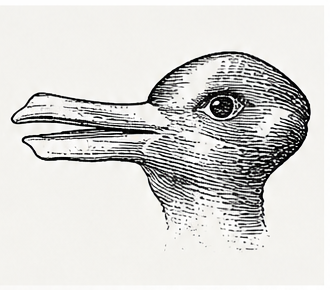
The duck–rabbit figure: the drawing remains unchanged, while perception shifts.
This is a simple illustration of the kind of shift that kensho points toward. In everyday life, we move through the world using concepts, labels and distinctions. A duck is a duck; a table is a table; hot is different from cold. We need these distinctions to communicate and function. They are part of the shared conventions through which society operates. But we can become so accustomed to this way of seeing that we cannot imagine experience outside it.
Our ordinary perspective is dualistic. We see things in terms of opposites and contrasts: subject and object, self and other, this and that. We perceive forms and distinguish one form from another. We understand things relationally, by comparing them with something else. We also rely on conventions — language, measurements, social customs, definitions and systems of agreement. These conventions are indispensable to ordinary life, but they shape the way we experience reality.
Buddhist teaching refers to this ordinary, conditioned way of experiencing the world as the mundane perspective, and to the cycle of existence within it as samsāra. The self is experienced as the subject, the point from which we view other people and things. Our perspective is also conditioned: everything we encounter arises through causes and conditions, including our own bodies, histories, education and habits.
Kensho does not mean that the duck disappears when we see the rabbit. The duck remains visible. Rather, another perspective becomes available. We discover that what appeared to be one thing can also be seen in another way. The two images are not separate pictures; they are two aspects of the same picture. In this sense, the experience moves beyond the insistence that something must be one thing or the other, and opens toward a recognition of unity.
The same metaphor can be extended to other pairs: form and emptiness, relative and absolute, conventional and unconventional, mundane and supramundane, self and non-self, conditioned and unconditioned. These terms point toward different ways of seeing. I will return to emptiness and non-self in more detail later, but for now the important point is that kensho gives us a direct glimpse beyond the habitual dualistic framework.
Conditioning, Samsara, and a Different Perspective
Everything we encounter is conditioned. Even a sheet of paper depends on an extraordinary network of causes and conditions. A tree had to grow, requiring a seed, water, sunlight and minerals. Someone had to cut the tree; the wood had to be transported and processed; machinery and human labour were involved in turning it into paper; and the finished paper had to be distributed. The paper is not an isolated thing. It is the result of many interconnected conditions.
The same is true of ourselves. We are conditioned by our DNA, the food we eat, our families, our education, our culture and our experiences. Our ordinary way of seeing tends to identify a thing as a separate object, but a wider perspective reveals the network of conditions on which it depends.
Kensho can occur during meditation, but it is not limited to the meditation cushion. It may happen at any time, as a sudden shift in perspective. The duck-and-rabbit image helps illustrate this: the duck is still there, but suddenly the rabbit is visible too. The ordinary perspective is not erased; rather, we have discovered that it is not the only possible perspective.
In this sense, kensho is a breakthrough in our habitual way of seeing. We gain a glimpse beyond the usual subject-object division and the assumption that things exist independently in the way they appear to us. The experience is not simply an intellectual conclusion. It is a direct shift in how reality is perceived. Without such a glimpse, Buddhist teachings about emptiness, dependent arising and non-self can remain theoretical concepts.
Non-Self: Beyond the Constructed Identity
The term non-self needs to be understood carefully. It does not mean that the empirical, sensing person simply disappears. We continue to see, hear, feel and function in the world. What is being questioned is the idea of a separate, self-existing identity that can be defined independently of everything else.
A sheet of paper can be called ‘non-paper’ in this sense. It is not that the paper does not exist. Rather, when we look closely, we see that it is also a tree, sunlight, water, minerals, labour, transport and many other conditions. It is not an independent thing that exists entirely by itself. Similarly, non-self means that the self cannot be defined in isolation. What we ordinarily take to be a fixed identity is a construct arising through many interdependent elements.
It is useful to distinguish between the empirical self and the constructed or metaphysical idea of self. The empirical self is the living, sensing person who continues to function. The constructed self is the story or identity we create and regard as an independent entity. In the lecture, these are distinguished by using a lowercase ‘self’ for the empirical person and a capitalised ‘Self’ for the metaphysical construct. The experience of non-self challenges the latter, not the ordinary fact that we continue to live and experience.
The experience that Zen calls kensho is not exclusive to Buddhism. Different religious and cultural traditions have described experiences that may share aspects of this shift in perspective. Mystical experiences in Christianity, for example, have been interpreted within Christian language and symbols. Other cultures have articulated profound experiences through their own cosmologies and traditions. The language used to describe an experience depends in part on the cultural framework available to the person who has it.
This raises an important distinction between the experience itself and the symbols through which it is interpreted. A person may have an experience and then understand it through the language of God, Jesus, ancestors, spirits, nature, Buddhas, bodhisattvas or other archetypes. These symbols can provide a meaningful framework, but there is also a danger of becoming attached to the interpretation and losing sight of the experience to which it points.
Zen places particular emphasis on seeing through symbols and conventions. This does not mean that symbols have no place in ordinary life. We need language, concepts and shared conventions in order to communicate and function. The practice is to avoid mistaking those symbols for the reality they represent, and to continue letting go of the images and assumptions through which we habitually interpret the world.
The question ‘What is this, really?’ cannot always be answered through ordinary logic. We can analyse a stick scientifically and describe its composition, but the question of seeing it as it truly is points beyond a set of definitions. Logic is valuable within the framework of ordinary distinctions, but it is limited by the very concepts through which it operates. Zen uses methods such as koan practice to challenge those habitual limits. We will explore koans in a later lecture.
The Two Truths and Their Integration
The distinction between ordinary and awakened perspectives has parallels in the Mahāyāna teaching of the two truths. These are often described as conventional or relative truth, and ultimate or absolute truth. The conventional perspective is the world of distinctions, relationships, language and everyday transactions. The ultimate perspective points beyond the assumption that things exist independently and permanently in the way they appear.
The philosopher Nāgārjuna is closely associated with the development of this way of articulating the two perspectives. Later Buddhist thinkers explored how these perspectives relate to one another. In the account presented here, Vasubandhu is associated with a further emphasis: the need to integrate the two rather than becoming fixed in either one.
A danger can arise after an awakening experience. We may become attached to the non-dual perspective and create a new division between the awakened and the ordinary, or between the absolute and the relative. We may imagine that the task is simply to remain in the ‘rabbit’ perspective and leave the ‘duck’ behind. But we still live in the everyday world. We need to communicate, work, care for others and participate in ordinary life.
The challenge is therefore to integrate the two perspectives. We need to see beyond the constructed self, but we also need to return to the world in which the empirical self functions. We cannot simply discard the conventional perspective. We need to be able to see both the duck and the rabbit, recognising them as aspects of one reality.
This integration is sometimes described as true self. It is not a return to the idea of a separate metaphysical identity. Rather, it is the capacity to see beyond the constructed self and then live that understanding within the ordinary, conditioned world. The work is to bring the insight of non-self back into everyday relationships and responsibilities. This is a difficult journey, and in Zen it is regarded as a central part of practice.
The Third Aim: Integration and the Personalisation of Kensho
The third aim of Zen is the integration of the kensho experience. In our practice, this can be described as personalising the experience of kensho — or, more broadly, personalising Buddhism. It is not enough to know about the teachings or to have had an awakening experience. The insight needs to become part of our character. It needs to be expressed in the way we live and act from day to day.
This is also a form of wisdom practice. Koan work, which we will explore in another lecture, is one way of continuing this process. A glimpse of non-duality does not mean that we are now completely awakened or that all our habits have disappeared. As one teacher in our school observed, even when non-self has been realised, emotions and delusions may remain stubbornly rooted. The patterns we have developed through our lives do not simply vanish because we have had an important experience.
The intensive practice that follows an awakening experience is therefore essential. Some Zen teachers suggest that the real work begins at that point. The experience provides a new reference point, but the task is to clarify it, deepen it and allow it to transform the way we meet ordinary life.
Kensho may occur more than once. As practice continues, further experiences and insights may arise. These are not all necessarily the same as ordinary psychological insights. A psychological insight may help us understand a pattern or emotion; a kensho experience involves a more fundamental shift in perspective. Both may occur in practice, but they should not be confused.
The degree and impact of an experience can vary. Some accounts in Buddhist texts describe profound realisations in which karma is said to be completely dissolved. Such accounts indicate the depth that awakening is understood to have in the tradition. In ordinary practice, however, we should not assume that a single experience makes someone perfect or free from every difficulty. The work of integration continues.
Kensho, Ethics, and Personal Transformation
An awakening experience can be transformative, but it does not automatically guarantee ethical behaviour. A person may have a genuine experience and yet fail to continue practising or integrating it. Some people have a significant experience and then move in another direction. Others continue with practice and find that their relationship to the world changes over time.
The experience itself is not a substitute for ethical development. It may contribute to a less self-centred way of seeing and can make aspects of life feel less burdened by habitual dualistic thinking. But ethical practice is also necessary. The two dimensions support one another, yet they are not identical. A person can have an awakening experience without having developed the ethical maturity that should accompany a sustained Zen practice.
This is why ethics needs to be understood as a parallel and essential dimension of the path. It is not enough to pursue unusual or powerful experiences. The question is how insight is expressed in our conduct, our relationships and the way we respond to others. We will explore the relationship between Zen practice and ethics in the next lecture.
A Note of Caution
The process of letting go can be unsettling for some people. Sitting quietly and loosening our usual sense of identity may bring up fear or uncertainty. People differ in their readiness for this kind of practice, and it is important not to assume that everyone should pursue it in the same way or at the same pace.
A reasonably stable sense of self can provide a foundation to which we return as practice deepens. If a person is experiencing significant psychological difficulties, or is already engaged in therapy, it is sensible to discuss the suitability of intensive meditation with their treating professional. The practice should be approached with care rather than through pressure or force.
An awakening experience may involve strong emotion — laughter, tears or other responses — but the important point is not to seek a dramatic experience. Kensho cannot simply be willed into existence. Meditation is one established way of cultivating the conditions in which it may occur, but the timing and form of such an experience cannot be guaranteed.
The aim is not to chase an experience. The aim is to practise steadily, develop concentration, learn to let go and allow the process to unfold. The first aim develops the capacity for practice; the second may bring a new way of seeing; and the third is the long work of bringing that understanding into the whole of our lives.
The Three Aims as One Continuing Path
The three aims of Zen are not three unrelated achievements. Joriki, the power of concentration, prepares the ground. Kensho, the experience of seeing one’s true nature, offers a glimpse beyond the ordinary dualistic perspective. Integration then brings that insight into the world of everyday experience, where it must become part of our character and conduct.
The first aim is developed through consistent meditation and the repeated practice of returning to the object. The second is not something we can manufacture, but concentration and the letting go of habitual patterns help create the conditions in which a shift of perspective may occur. The third is the continuing work of clarifying and embodying what has been seen.
Zen is therefore not simply about becoming calm, nor is it about collecting extraordinary experiences. It is a path in which concentration, awakening and integration belong together. We begin by sitting and practising. We learn to recognise the limits of our usual way of seeing. And, when a different perspective opens, we continue the work of bringing it fully into our lives.